
Statistics AI solver: Get the solution in one click
Quickly solve statistics problems, no matter how complex, and get a clear breakdown of the solution.
Quick and accurate AI statistics solver
Calculate variance, apply Bayes’ theorem, perform regression analysis, or complete any other statistics assignments in just a few clicks. Just share the instructions, and this solver will generate accurate answers.
For your convenience, the tool supports a variety of formats. You can simply snap a picture of your instructions and upload them as an image to get the solution.
Aside from the correct answer to your problem, you'll also get a detailed breakdown of the solving process to learn from.
Why use our tool?
Instant solution to any problem
Why spend hours on statistics homework? Our solver will complete any assignment in seconds.
The best AI for statistics
Trained on large datasets of correctly completed statistics assignments, the tool can solve even the most complicated problems.
Range of input options
Enter your prompt or upload the instructions as a PNG, JPEG, PDF, TXT, DOC, or DOCX file of up to 10 MB.
No subscription
Students aren't made of money. We get that and offer you help with statistics completely free of charge.
How to use the solver
Just follow this simple guide to use our statistics solver with steps:
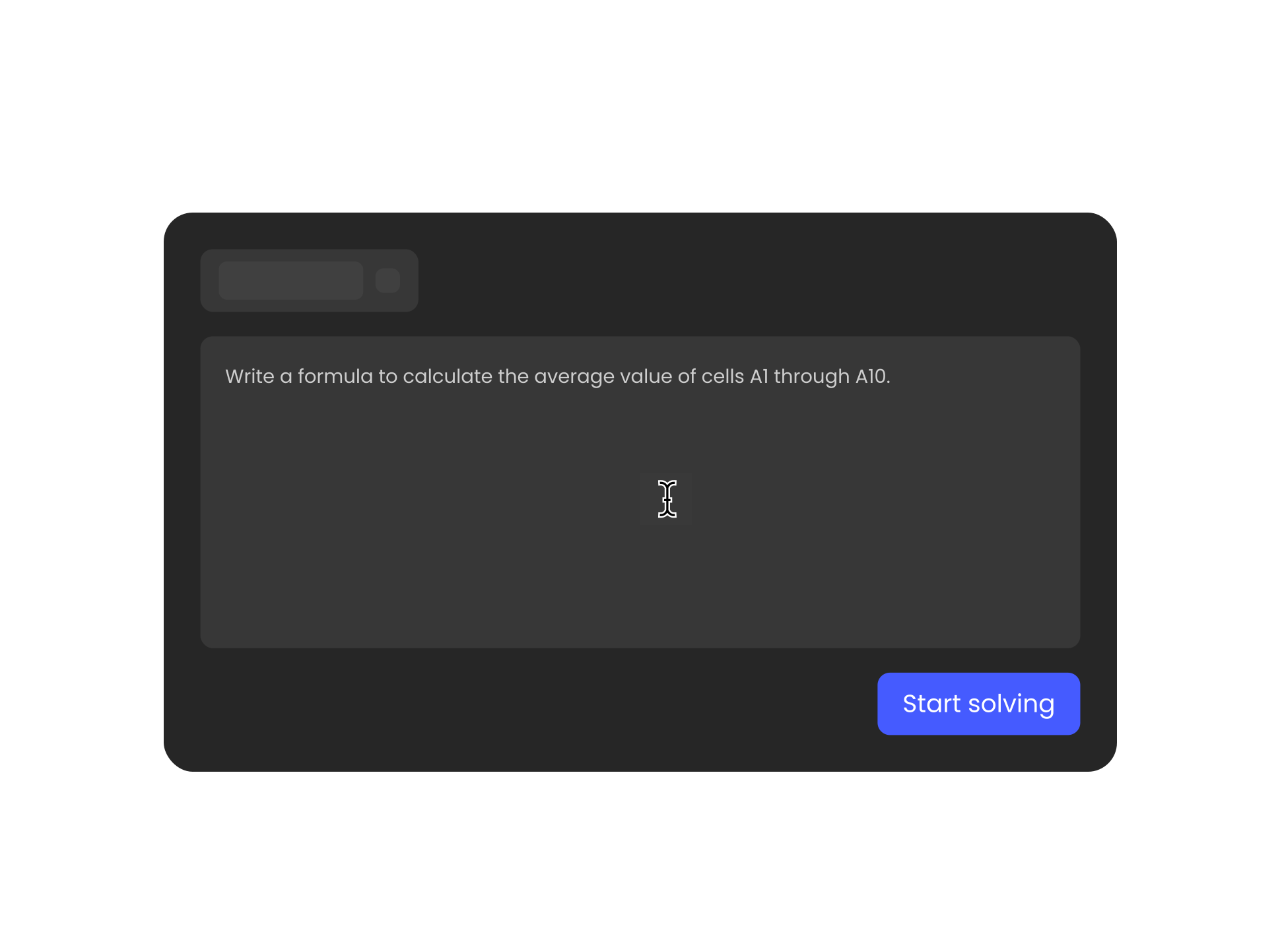
Write a prompt
Enter the question into the statistics helper or upload a file with your instructions. Add as many details as needed.
Let the tool do the task
Get the solution
What makes this solver special?
100% free
You can use our statistics AI solver free of charge.
No sign-up required
All features of the solver are available to unregistered users.
No limits on use
Use this statistics problem solver as much as you need, with no daily limits.
High accuracy
No AI tool can guarantee 100% accuracy, but our solver comes as close as possible.
Clear explanation
Prompt our stats AI solver to give you a detailed solution breakdown to help improve your knowledge.
Instant solutions
No matter how complex your problem is, the solution won’t take longer than a few seconds.
Recent feedback from our users
We’re continuously working on making our solver more accurate and convenient. Our biggest motivation is positive feedback from our users. Here’s some of it:
What to know before using our statistics solver
What types of problems can it help solve?
This tool is a perfect statistics calculator for almost all common problem types, including:
- Descriptive statistics. Use the solver to summarize, organize, and describe data. It’s great at all basic measures, such as mean, median, mode, variance, and standard deviation.
- Probability problems. Our tool can apply rules of probability, conditional probability, and probability distributions.
- Hypothesis testing. With enough data and context, our solver can help you support or reject a hypothesis using t-tests and z-tests.
- Confidence intervals. You can also use the tool to estimate a population parameter using sample data and determine a range where the true value likely falls.
- Regression and correlation analysis. Finally, our solver can help you examine the relationships between variables and even build prediction models.
This is just the tip of the iceberg. Our solver is trained on large databases of correctly solved problems, so there’s hardly any statistics task it can’t solve. And, in case your problem has more to do with math than statistics, you can count on the MathGPT AI solver instead.
Just make sure you’ve given the tool all the necessary data to solve your assignment. If you have visuals that might help, you can attach them, too.
What will the solution look like?
Unlike most similar tools, our solver doesn’t just give you the correct answer. Just like our geometry AI solver, it breaks down the entire solution step by step to help you understand where the answer is coming from.
You’ll get a sequence of steps (Step 1, Step 2, and so on), and each will include both calculations and the explanation of the relevant rules and parameters. If a specific formula is used, you’ll see both the formula and its use with your data.
Why is it helpful? You’ll be able to go through the entire solution step by step and analyze every action needed to solve problems like yours. If you’re interested in getting better at statistics yourself, our solver can act like a personal tutor – except free and available whenever you need it. If you use it enough, you’ll notice how your statistics knowledge and problem-solving abilities are improving.
That said, if statistics isn’t a subject you want to spend much time on and prefer a quicker answer, you can skip the step-by-step solution breakdown and scroll down to the Final Answers section. It features a short answer to your problem or question without extra explanations.
Why use AI for statistics homework?
How you use this tool is entirely up to you. It can complete your homework for you, help you understand a problem you’re stuck on, or reveal mistakes in your calculations.
Here are just a few common ways to benefit from our solver:
- To check your solutions for accuracy. AI tools aren’t just helpful for students who don’t want to complete their homework themselves. If statistics is an important subject for you, or you enjoy solving problems yourself, you can use our solver to check the accuracy of your solutions.
- To save time on homework. However, not everyone enjoys or even needs to spend hours on statistics homework. If you’d much rather focus on other subjects or something other than school, this tool is a great way to complete homework more efficiently.
- To improve your own knowledge and skills. Clear, step-by-step explanations of solutions can help you understand the material you struggle with. If you carefully review each step-by-step solution, you’ll soon notice that your own statistics skills are getting better.
- To have access to homework support 24/7. Thanks to the detailed solution breakdowns, you can use our solver instead of a tutor. But it doesn’t have limited office hours and is completely free.
What to include in your prompt for the best results
Our solver does well even with minimal guidance, but to get the most accurate solutions, we recommend sharing all key details, including:
1. Clear instructions. Type the problem or, if you have detailed instructions from your instructor, attach them. We recommend mentioning the type of task as well (hypothesis test, probability, regression, etc.), though this isn’t necessary in most cases. Our solver can identify the type of the task from the instructions.
2. Relevant images, tables, or graphs, if available. If you have any supporting materials, please attach them as well. Datasets, charts, and research tables are some of the common types of visuals used in statistics assignments.
3. Significance levels or parameters when needed. When it’s necessary for correct calculations, be sure to include relevant values: significance levels, confidence levels, sample sizes, or distribution parameters.
4. Relevant context if necessary. If you think this might help, add background information about the problem. For example, mention what the data represents or what you are trying to prove or analyze.
The same recommendations apply to other problem-solving tools, too, including our accounting AI solver. The rule of thumb is that the more detailed the input, the more accurate the output.