
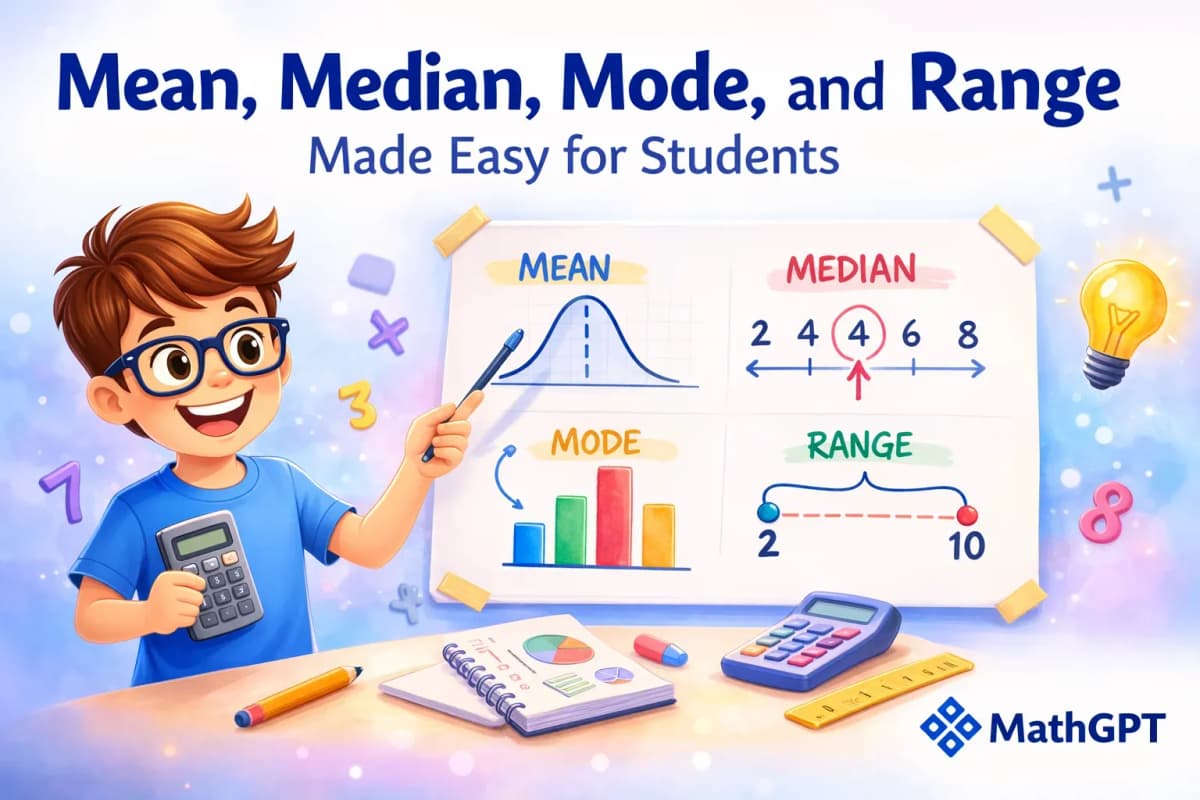
What Measures of Central Tendency Reveal
Measures of central tendency are tools that help you describe a group of numbers with one simple value. In plain English, they show what is typical or central in a data set. The three main ones are mean, median, and mode. You have probably seen them in math class, but they also show up in real life more than you think.
They can help you understand test scores, sports points, sleep hours, or even how many views a video gets. Each one gives you a slightly different angle, which is why they matter. You are not just doing math for no reason here. You are learning how to read patterns. And if you want to check tricky homework, an AI statistics solver can show you solutions step by step.
What Is Mean in Math?
The mean is the average of a set of numbers. To calculate it, add every value in the group together and divide that total by the count of numbers you have. That gives you one number that represents the whole set. Pretty useful when you want a quick summary.
You will see the mean in test scores, daily temperatures, sports stats, and plenty of school assignments. It works best when the numbers are fairly balanced and there are no huge outliers throwing everything off. Mean gives you a solid snapshot of what is typical. It is often the first measure students learn, and for good reason. Once you get the steps, it feels simple and very doable.
How to Find the Mean of a Data Set
Finding the mean of a data set gets easier once you see how the pattern works. The mean is what most people call the average. Add up all the numbers in your set, then divide by how many there are.
For example, imagine a student scored 72, 80, 76, and 84 on four quizzes. First, add the scores:
72 + 80 + 76 + 84 = 312
Now count how many scores there are. There are 4. Next, divide 312 by 4:
312 ÷ 4 = 78
So, the mean score is 78.
An easy way to keep it straight: sum everything up, then split it evenly.
Mean Math Example
Here is a mean math example using one simple data set: 4, 6, 8, 8, 10, 12.
First, add the numbers:
4 + 6 + 8 + 8 + 10 + 12 = 48
Next, count how many numbers are in the set. There are 6 values.
Now divide:
48 ÷ 6 = 8
So, the mean is 8.
This tells you the average value of the whole group. Even though the numbers are different, 8 gives you a quick picture of the center. Nice, right? It helps you understand the set faster without focusing on each number one by one.
AI tools like Math-GPT can instantly calculate mean, mode, median, and range for any dataset. See how students are using ai for such stats tasks in recent surveys.
What Is Median in Math?
Once your numbers are sorted from lowest to highest, the median is whichever value falls right in the middle. It is a great way to find the center when one very high or very low number could mess up the average. That is why the median can give a clearer picture of what is typical in a data set.
Think about test scores where one student got much lower than everyone else, or a set of phone screen times where one day went completely off the rails. The median helps you see the middle point without letting that odd result take over. It gives you a calmer, more balanced picture of the data. Very dramatic numbers do not get to steal the spotlight here.
How to Find the Median
Start by arranging your numbers in order from smallest to largest before finding the median. Then locate the value sitting in the middle. With 5 numbers, the job is easy. In 2, 4, 7, 9, 11, the middle number is 7, so the median is 7.
With an even number of values, you use the two center numbers. In 1, 3, 8, 10, the middle pair is 3 and 8. Add them to get 11, then divide by 2. That gives us a median of 5.5, which is the point where the data is divided into two equal halves. And that's really all there is to it: sort your numbers, then locate the center.
What Is Range in Math?
Range tells you how far the numbers stretch in a data set. To find it, take the highest value and subtract the lowest one. The result shows the gap between the smallest and largest numbers.
Range does not tell you the middle or the average. It captures how much variation exists across your numbers, which comes in handy when you want to see whether values were consistent or all over the place. Two students could share the same mean score, yet one might have had much wilder swings between their highest and lowest results. Range helps you spot that fast. It gives extra context, which is why it works well alongside mean, median, and mode.
Range in Math Definition Through an Example
A real-life example makes the range much easier to understand. Imagine your screen time for six days was 2, 3, 3, 4, 5, and 7 hours. The smallest value is 2, and the largest is 7. Subtract 2 from 7, and you get a range of 5.
What does that tell you? Your screen time changed by as much as five hours across those days. That is a pretty wide gap. Maybe one day was packed with homework, and another turned into a full scrolling session. Range helps you notice that kind of variation fast, which is why it is useful in everyday life.
How to Find Range in Math
Finding the range is straightforward. It takes just three steps:
• Identify the lowest number in the set
• Find the highest number in the set
• Subtract the smallest from the largest
Using the same data set, 4, 6, 8, 8, 10, 12, the smallest value is 4 and the largest is 12. Then you do 12 - 4 = 8.
So, the range is 8.
That single result shows how wide the data set is from end to end. It is a quick way to tell whether the numbers stay close together or have a wider gap between low and high values.
What Is Mode in Math?
The mode is simply the number that shows up most frequently in a set of data. It helps you spot what shows up more than anything else. Because of that, the mode is useful when you want to find the most common result in a group of numbers.
While the mean and median are concerned with the middle of your data, the mode is all about repetition. Depending on your dataset, you might end up with one mode, several modes, or none at all. It depends on how often the values repeat. Mode is often one of the quickest measures to find, which makes it a helpful starting point when you first look at a set of numbers.
Mode Definition in Maths Through Examples
A real-life example makes mode easy to spot. Imagine six students got these quiz scores: 7, 8, 8, 9, 10, 8. The number 8 appears three times, so it is the mode.
Or think about the number of coffees students bought this week: 1, 2, 2, 3, 2, 4. Again, 2 is the mode because it shows up most often.
This matters because mode helps you find what is most common, not what is average. That can be more useful when you want to notice habits, trends, or popular results in real life.
How to Find Mode in Math
To work out the mode, scan the data set and see which value repeats the most. Whichever value appears most often in the dataset is your mode.
Take this set: 4, 6, 8, 8, 10, 12. Almost every number appears one time, but 8 appears two times, so 8 is the mode.
Sometimes two values tie for the most appearances, giving you a dataset with two modes. In other cases, no number repeats at all, so the set has no mode.
A good way to remember it is this: find the number that appears most often, and you have found the mode.
What Is the Difference Between Mean and Median?
The difference between these two is easiest to see with a real student example. Say your last five quiz scores were 72, 74, 76, 78, and 98. The mean is 79.6 because that high 98 pulls the average up. The median is 76 because it is the middle score when the numbers are in order.
Now try a different set: 72, 74, 76, 78, and 40. The mean drops to 68, even though most scores are still in the 70s. The median stays 74, which gives a steadier picture of your usual result. That is why the mean is useful when you want the full average, but the median is better when one score is unusually high or low. If your teacher wants the overall class average, the mean makes sense. If you want to understand what score was more typical for the group, the median often helps more.
| Measure | Main Job |
|---|---|
| Mean | Shows the overall average |
| Median | Shows the center point |
| Mode | Shows the value that repeats most |
| Range | Shows the gap from lowest to highest |
One Data Set: Mean, Median, Mode, and Range
Let’s use a fresh example: 72, 75, 75, 78, 84, 90. You can imagine these as quiz scores from six class assignments. This set works well because it lets you see each measure do a different job.
Start with the mean. Add the scores: 72 + 75 + 75 + 78 + 84 + 90 = 474. Then divide by 6. 474 ÷ 6 = 79, so the mean is 79.
Now find the median. The numbers are already sorted in ascending order. Since there are six values, you need the two middle numbers, which are 75 and 78. Add them to get 153. Divide by 2. The median is 76.5.
Next is the mode. This value shows up more frequently than the others. In this set, 75 appears two times. All the other numbers appear once, so the mode is 75.
Finally, find the range. Take the highest number, 90, and subtract the lowest number, 72. 90 - 72 = 18, so the range is 18.
Putting all four concepts side by side makes them easier to compare. Think of it this way: the mean gives you the overall average, the median finds the middle value, the mode highlights what appears most often, and the range reveals how much the numbers vary from low to high. When you view all four together, the numbers become easier to understand. Each answer gives you a different clue, and together they help you read the whole set more clearly.
Math shows up in surprising places, too. Even in something creative, like studying the first AI generated image, you might look at averages, popular results, or how much values vary across a set.